 ZW News HD Latest Breaking News, Entertainment, Sports & Pakistan Updates
Related Articles

The Pakistani military’s media wing warns against challenging Pakistan, and an Air Vice Marshal states that the Pakistan Air Force has shot down 8 Indian aircraft while suffering no losses.
BY Mahnoor | 08-May-2026
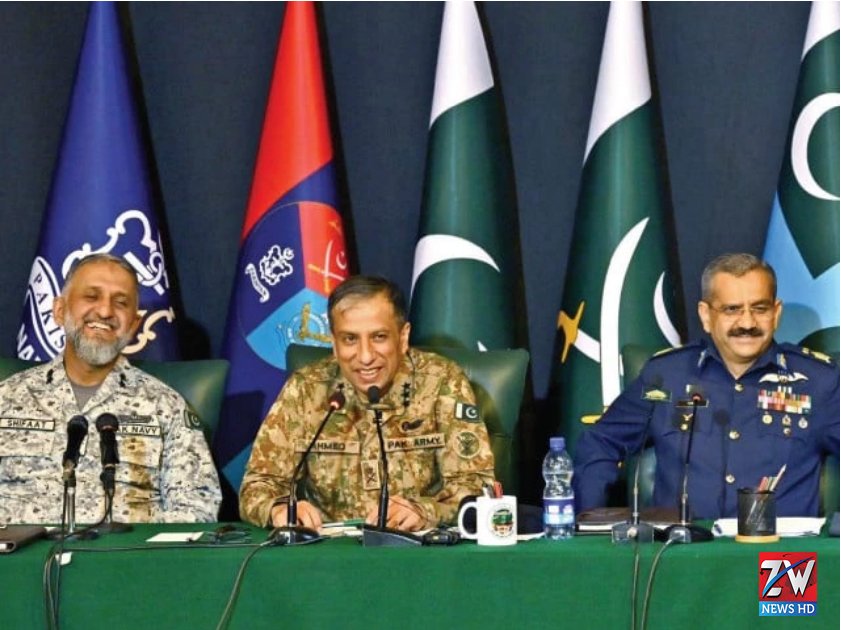
RAWALPINDI: The head of Inter-Services Public Relations, Lt Gen Ahmed Sharif Chaudhry, stated on Thursday that “nobody can hurt Pakistan.” He mentioned that we defeated a much larger enemy in every area and added that the military is prepared to react to any future attacks.
At a press conference celebrating the first anniversary of Marka-e-Haq’s completion, the DG ISPR, along with high-ranking Navy and Air Force officers, congratulated the country. He stated that Pakistan had decisively defeated India on every level.
General Chaudhry stated, “Last year, we defeated India’s prestige. We’ve always maintained that Pakistan is untouchable. We were prepared then, and remain so now; if anyone questions our readiness, we’ve already demonstrated our capabilities once.”
“Pakistan won against the enemy in every way and changed how wars are fought during the Battle for Truth. Pakistan was successful in fighting in the air, on land, at sea, and online,” he said.
The military’s media wing stated that India has been falsely blaming Pakistan for terrorism for a long time and staging fake incidents to support this claim. They added that Pakistan was accused in the Pahalgam incident very quickly, before any investigation took place.
He also said India’s ‘terrorism story’ is over, calling India the biggest terrorist. He dared India to name the terrorist camp they attacked, claiming India uses terrorism against its own people to blame others.
The military’s spokesperson stated that India supports terrorism, alleging India and Afghanistan are linked to all terror attacks in Pakistan. He also mentioned that Afghanistan’s foreign minister asked India for help.
He added that India hadn’t shown any proof about the Pahalgam event. He said a police report was made quickly after it happened, but a year later, no evidence has been found.
Lt Gen Chaudhry stated that the events of Marka-e-Haq are widely known, not only in Pakistan but also by every child in India. He advised India to be truthful, noting that Hindutva ideology is being forced upon minorities in India.
Indian politicians acted more like fighters than leaders, claiming that politics had corrupted India’s military. He also stated that India was using the terms ‘Fitna-al-Khawarij’ and ‘Fitna-al-Hindustan’ because it was frustrated by its defeat.
He said Pakistan helps keep the region stable and works for peace. He emphasized that a war between two countries with nuclear weapons would be insane.
The DG ISPR said that on August 14, they will show the public a little of Pakistan’s strength so that people can’t say they were not warned. He promised to protect Pakistan’s security and independence no matter what.
He also said that Kashmir isn’t just India’s problem, but a recognized global issue with unresolved UN decisions. He claimed India is mistreating Muslims in Kashmir and people in Manipur.
The military’s spokesperson highlighted the importance of the defense agreement between Pakistan and Saudi Arabia, noting Pakistan’s key role in protecting Islam’s two most sacred places.
When asked a question, he explained that Pakistan was selected to safeguard Harmain Shareefain (the Masjid al-Haram in Makkah and Masjid-e-Nabawi in Madinah). He added that protecting these holy places is closely connected to Saudi Arabia’s national security.
He also emphasized that any danger to Saudi Arabia would be seen as a danger to Pakistan itself.
Chaudhry said the defense agreement shows the long-term relationship between Pakistan and Saudi Arabia in many areas. He stated, “We will do what we promised and keep our promises.”
When asked about Operation Ghazab lil Haq in Afghanistan, he said it was still happening.
Chaudhry stressed that Pakistan isn’t hostile to Afghanistan or its people. He said, “We have no issues with Afghanistan, especially its people,” highlighting that Pakistan has always been a friend and safe place for Afghan refugees.
The military spokesperson emphasized Pakistan’s role as a supportive and welcoming nation to Afghans, calling it an example of strong friendship and kindness. They said there is no better example of this.
He said the operation was a key part of Pakistan’s plan to fight terrorism.
Speaking at the press conference, Rear Admiral Shifaat Ali Khan called Marka-e-Haq a ‘historic and memorable’ event, where Pakistan’s navy made a strong impact on India’s naval power. Looking back at what happened before the conflict, he mentioned that the Indian Navy had often boasted about its strength and control in the area.
He wondered why the Indian Navy didn’t confront Pakistan during the war. He said it’s still a question why their navy wasn’t brave enough to challenge Pakistan.
He questioned why the Indian Navy didn’t fight Pakistan in the war. He believes it’s still unclear why they weren’t bold enough to challenge Pakistan’s navy.
He further shared that India attempted to use its ships in the northern Arabian Sea during the war. Their goal was to attack Pakistani ships and interfere with important sea trade routes. He stated, “The only reason for this action was to damage our economy by disrupting our sea trade and waterways.”
Rear Admiral Ali stressed that the country’s sea routes were still open, and important facilities and harbors were kept safe during the war.
He emphasized the Pakistan Navy’s alertness, saying they keep watching enemy actions using their advanced monitoring technology.
“The Pakistan Navy and Air Force were ready to attack the Indian aircraft carrier Vikrant,” he remembered. He noted that even though they were ready, the Indian Navy stayed in safe areas, and the conflict didn’t get any worse.”
Air Vice Marshal Tariq Ghazi told reporters about successful attacks on India’s air and military bases. He called the operation very well-coordinated, saying the Pakistan Air Force’s defense and attacks were key to its success.
Ghazi mentioned that the Pakistan Air Force (PAF) carefully watched the Indian Air Force’s (IAF) strong initial setup, including important equipment and weapons. He emphasized that the PAF clearly won, scoring 8-0 against the IAF.
A high-ranking Air Force officer explained how well the attacks went, saying Pakistan’s offensive was very effective. He said they destroyed four Rafale fighters, a MiG-29, a Su-30, a Mirage 2000, and a drone.
He also said that Pakistan’s JF-17 Block III planes, made in Pakistan, attacked India’s S-400 systems.
Looking back at how well the operation went, AVM Ghazi mentioned that Marka-e-Haq had become a standard for air battles. He said it was the first time anyone had shown complete, wide-ranging operations and said it was a great example for air warfare experts to learn from.
He said the Pakistan Air Force’s reaction was “very strong and surprising” to India. They showed they had a powerful, locally made system for targeting and destroying enemies. Ghazi complimented the PAF’s skill in combining all its forces into one, strengthening its control in the conflict.
Ghazi said that going forward, the PAF is working on improving what it can do so it stays better than its enemies in future wars.