 ZW News HD
Related Articles
The US president stated that the blockade of Iranian ships will continue completely until a deal is made.
BY Mahnoor | 25-05-2026
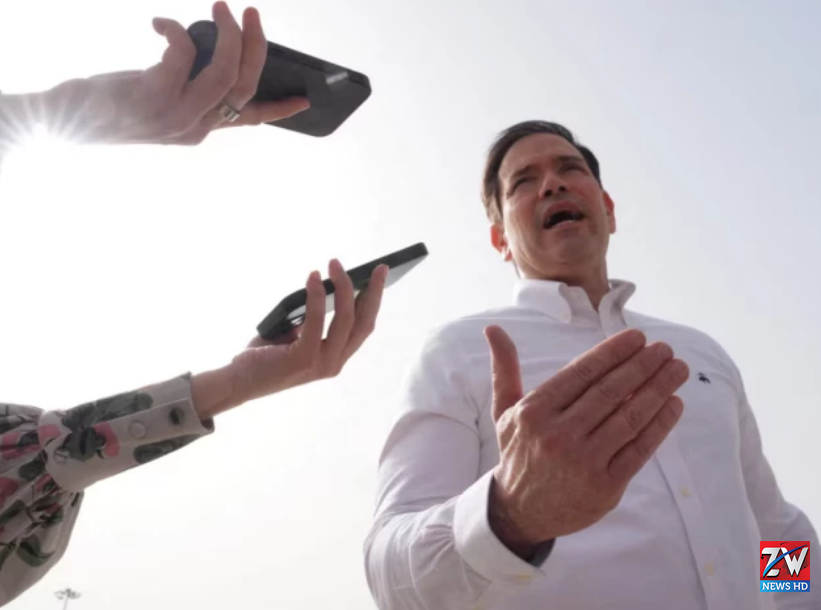
On Monday, US Secretary of State Marco Rubio said that there could be news “maybe today” about the discussions between Iran and the US to stop the war.
“Still working on it. We hoped to have news last night or maybe today,” Rubio told reporters in New Delhi, before flying to Agra to see the Taj Mahal.
The U.S. diplomat stated there’s a strong possibility to open the straits, and begin real, significant, and time-limited nuclear negotiations.
“I hope we can do it,” he said.
Rubio, visiting India for four days, stated that US President Donald Trump won’t make a poor agreement and that the US will fully explore diplomatic solutions.
“Like President Trump said, he’s not rushing and won’t make a bad deal. The President won’t agree to something bad. We’ll wait and see. We’ll try diplomacy first before considering other options,” he said.
In military conflicts, Iran’s approach is to do the same back to the other side. In diplomatic issues, they believe in responding to actions with actions, said Ebrahim Rezaei, the spokesperson for the Iranian parliament, on Monday.
Iran won’t give in to pressure or threats. If the U.S. wants a deal, they should negotiate. If they want high gas prices, they can keep making empty threats, he said on X.
Mohammad Bagher Ghalibaf, Iran’s main negotiator in talks with the US, has been voted again as the speaker of Iran’s parliament, according to the Fars news agency on Monday.
Trump says there’s no need to quickly make a deal with Iran, and the US will continue blocking them.
On Sunday, US President Donald Trump said he instructed his people to take their time and not quickly make a deal with Iran. This came after the government lowered expectations of a quick solution to the three-month-old conflict, which some thought was possible just a day before.
Trump stated on Truth Social that the US blockade of Iranian ships in the Strait of Hormuz will stay in place until a signed agreement is reached and verified. He also mentioned that both sides should take their time to ensure they get it right.
Iran’s government didn’t respond right away. But Tasnim, a news source connected to Iran’s Revolutionary Guards, said the US is blocking parts of a possible agreement. This includes Iran’s request to get back money that’s currently frozen.
Trump stated a day before that Washington and Iran had mostly agreed on a peace deal to reopen the Strait of Hormuz. This strait used to handle one-fifth of the world’s oil and natural gas shipments before the conflict.
The two groups still disagree on tough topics. These include Iran’s work on peaceful nuclear projects, Israel’s war in Lebanon with Hezbollah (who are supported by Iran), and Iran’s requests to end sanctions and get back billions of dollars in oil money that is currently frozen in foreign banks.
Finalizing the agreement details
A high-ranking official from the Trump administration informed reporters that an agreement wouldn’t be signed on Sunday. They said Iran’s system wasn’t progressing quickly enough. However, the official described the main points of the ongoing negotiations.
An unnamed official stated that Iran has agreed, tentatively, to open the Strait of Hormuz. In return, the United States would remove its naval blockade, and Iran would get rid of its highly enriched uranium.
He said the US knew that Iran’s top leader, Ayatollah Mojtaba Khamenei, had approved the main outline of the agreement.
Iran didn’t immediately confirm the agreement or explain what an ‘in principle’ agreement meant.
A US official stated that Washington planned to first reopen the waterway and end the US naval blockade. He added that agreeing on the specifics of the nuclear actions would require more time.
He disagreed with claims that Iran hasn’t agreed to get rid of its stored enriched uranium. The official stated, “It’s about the method.”
On Sunday, another high-ranking official said the suggested plan gives negotiators two months to finalize an agreement.
Iranian sources informed Reuters that in later steps, they might find ways to settle the disagreement about their enriched uranium supply. This could involve weakening the material while the UN nuclear agency watches.
Iran denies trying to build nuclear weapons, despite US and Israeli claims. It says it can enrich uranium for peaceful uses, but its uranium is much purer than needed for energy.
Reports say LNG ships passed through the Strait of Hormuz, heading to Pakistan and China.
On Monday, two ships carrying liquefied natural gas left the Strait of Hormuz, going to Pakistan and China. Also, a very large tanker carrying Iraqi oil for China left the Gulf on Saturday, after being stuck there for almost three months, according to shipping information.
The US and Israel started a war with Iran on February 28th, which has greatly reduced the number of ships passing through the Strait of Hormuz. Normally, about 20% of the world’s oil and LNG is transported through this strait.
These large ships are some of the few very big oil tankers leaving the Gulf this month. They’re using a route that Iran has told ships they must use. Last week, three of these tankers went to China and South Korea carrying 6 million barrels of oil.
The LNG tanker Fuwairit is passing through the Strait of Hormuz on Monday and is expected to unload its cargo in Pakistan on Tuesday, according to shipping data. The ship, which flies the Bahamas flag, loaded LNG at Qatar’s Ras Laffan port around March 28.
The agreement attracts criticism in the US.
Trump’s popularity has dropped because the war raised US energy prices. Congress tried to limit his power to act in the war. Trump has often talked about a possible deal to end the war that the US and Israel began on February 28. A fragile ceasefire has been in effect since early April.
Oil prices started the week at their lowest in two weeks. Brent crude oil dropped over 4% to $98.83 a barrel, the first time it’s been under $100 since early May. US West Texas Intermediate also fell over 4% to $92.03 a barrel.
Over the weekend, details of a possible agreement came out. Critics, such as former Secretary of State Mike Pompeo and some Democratic politicians, said it wasn’t much different from the 2015 Iran nuclear deal. That deal was made by former President Barack Obama, but Trump canceled it during his first term.
Senator Chris Van Hollen, a Democrat on the Foreign Relations Committee, stated that the proposed agreement would simply restore things with Iran to how they were before the war.
“I think this was a mistake,” Van Hollen said on the ‘Fox News Sunday’ show. “When you’re in a bad situation, you should stop making it worse, and it sounds like maybe that’s what we’re finally doing.”
Trump, who has been criticized by hard-line conservatives for being open to deals with Iran, defended himself.
Trump said on social media that if he makes a deal with Iran, it will be a good one. He also said not to listen to the critics who don’t know what they’re talking about.
Adding to possible problems, an Iranian military advisor to Khamenei stated that Tehran has the legal authority to control the Strait of Hormuz. It’s unclear if this means they’ll keep choosing which ships can pass through.
Iran’s military said that 33 ships went through the strait in the last day after Iran allowed them, which is much less than the usual 140 ships per day before the war.
Any agreement that strengthens the shaky ceasefire would ease market worries. However, it wouldn’t instantly solve the global energy crisis that has increased the price of fuel, fertilizer, and food.
Even if the war stops today, the Abu Dhabi National Oil Company said that normal oil flow through the strait won’t resume until early 2027.
The US and Israel bombed Iran, killing thousands, before the bombing stopped in early April.
Israel has killed thousands and forced many from their homes in Lebanon after invading it to fight Hezbollah. Iranian attacks on Israel and nearby Gulf countries have killed many people.