


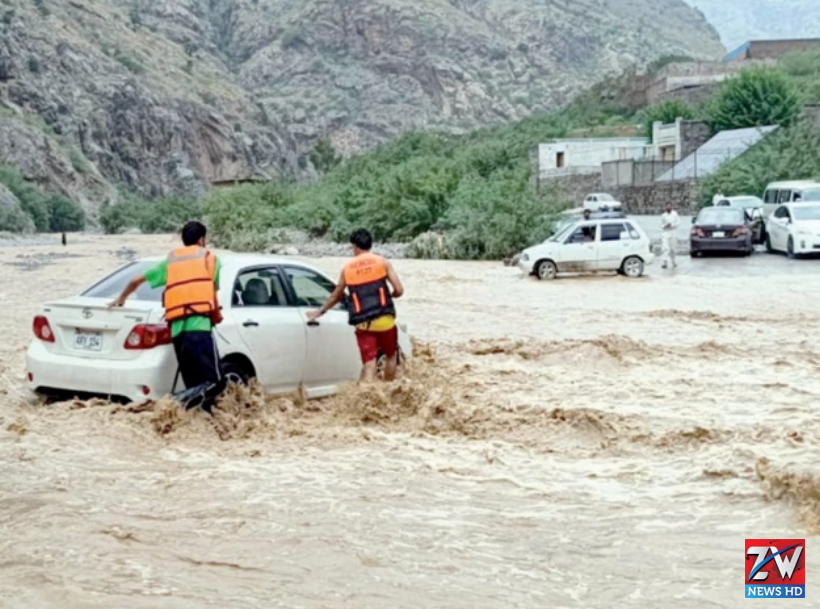
Six people died in Khyber and Azad Jammu and Kashmir because of flash floods and landslides.
By Mahnoor | 21-07-2026
PESHAWAR/ISLAMABAD: Water levels rose in Pakistan’s main rivers on Monday because of heavy monsoon rains. Officials said water released from Indian dams upstream also added to the flow. This caused new flood warnings, opened spillways at Tarbela Dam, and increased monitoring of the river system.
Official numbers show the total flow in rivers across the country reached 454,000 cubic feet per second.
The Chenab River had about 130,000 cusecs of water. The Indus River had 232,000 cusecs at Tarbela, 243,000 at Kalabagh, 247,000 at Chashma, 210,000 at Taunsa, 164,000 at Guddu, and 110,000 at Sukkur Barrage.
The Jhelum River’s water flow also went up, with 57,000 cusecs at Mangla Dam.
Officials said the river levels went up because of heavy monsoon rains and the opening of spillways at Indian dams upstream. The total water stored in the country’s reservoirs was 6.1 million acre-feet.
Also, authorities warned that a very hot heatwave in Skardu and other northern areas, where temperatures hit 37 degrees Celsius, caused snow and glaciers to melt faster, raising the risk of glacial lake outburst floods.
To handle the water coming in, officials opened the gates at Tarbela Dam and chose to keep the reservoir as empty as possible to make room for floodwater from northern areas.
The gates were opened at 4pm on Sunday and were planned to close at noon on Monday.
The Flood Forecasting Division said at 6am that there was still some flooding at Head Khanki and Head Qadirabad on the Chenab River, but other rivers like Indus, Jhelum, Ravi, Sutlej, and Kabul were at normal levels.
Tarbela Dam’s water was at 1,506.01 feet, which is 58% full, compared to 80% last year. Mangla Dam was at 1,175.85 feet, or 40% full, compared to 50% a year ago.
In the past day, the Chenab River had the highest water flows. Head Marala recorded 178,467 cubic feet per second, Head Khanki had 169,146, and Head Qadirabad had 157,156, all at medium flood level. The Jhelum River at Mangla had a flow of 70,000 cubic feet per second.
The Flood Forecasting Division warned that over the next day, medium to high flooding could happen at Head Marala, Head Khanki, and Head Qadirabad. Low to medium flooding was expected at Mangla on the Jhelum River. Low-level flooding was also predicted at Tarbela, Kalabagh, and Chashma on the Indus River.
Water levels went up in the Deg Nullah at Kingra Bridge on the Ravi River too. The water flow there was 10,193 cusecs, which is a low flood level.
Later, officials said that water coming into Head Marala was 110,355 cusecs, and water going out was 88,082 cusecs, which means low flooding. At Mangla, water flowing into the Jhelum River jumped to 133,000 cusecs, causing medium flooding. But the water released downstream was still normal.
People who are hurt or killed in an accident or war
At the same time, worsening weather also killed people in different areas of the country.
In Khyber district, three people died after being swept away by sudden floods caused by heavy rain in Landi Kotal.
A Rescue 1122 spokesperson said the number of dead went up to three after rescue teams found the bodies of a woman, a man, and a child. The woman and man were found in the Jabba Khwar area of Jamrud, and the child’s body was found in Parang Sam with help from local people.
According to the spokesperson, Rescue 1122 divers and local volunteers worked together in a search before giving the bodies to the right authorities for legal steps. The rescue service told people to stay away from rivers, streams, and seasonal water paths during heavy rain and to call 1122 right away in emergencies.
Heavy rain in Landi Kotal and other high areas of Khyber district caused floods. Strong streams from seasonal rivers washed away many cars. Officials said no more deaths were reported.
Also, heavy rain hit Peshawar and Nowshera, making the weather much cooler after many hot and humid days.
In Azad Jammu and Kashmir, three people from one family died, and two more were hurt when heavy rain caused a landslide that hit a house in Hatli Bala village, in Nikyal area of Kotli district.
Officials said a mother, her daughter, and her son died when the hill fell onto the house. Their bodies were found in the rubble and buried, while the injured were taken to the local hospital. Also, a full truck was carried away by floodwater in the same area.
Heavy rain and a sudden cloudburst caused a lot of damage in the Neelum Valley, breaking roads and buildings and stopping normal life.
In other places, strong rain kept hitting Hazara Division, making streams and small rivers overflow, causing landslides, and blocking many roads.
In Abbottabad, heavy monsoon rains caused big problems in daily life. Flooding in the Tarnawai Nullah cut off a road in Reala, stopping traffic because there is no bridge there. Hundreds of trucks carrying phosphate were stuck on both sides of the flooded road.
Rain also fell off and on in Balakot and Kaghan Valley, where flash floods closed the road to Saif-ul-Muluk Lake and another road at Sahuch. Machines from the Kaghan Development Authority (KDA) and the National Highway Authority (NHA) were used to clean up debris and get traffic moving again, but many tourist vehicles and jeeps remain stuck.
In Haripur, heavy rain flooded low-lying areas after local streams overflowed. The local leader in Haripur said people living near streams were moved to safer places.
The Indus River’s higher water level also filled Tarbela Dam, so officials opened its spillways to let out extra water.
Officials told people not to travel unless needed, stay away from rivers, streams, and places that might flood, and follow government advice because the rainy season is still affecting the northern parts of the country.
Also watch this :













Leave a comment