 ZW News HD Latest Breaking News, Entertainment, Sports & Pakistan Updates
Related Articles

The ongoing discussion focuses on the continuing financial gap between the national government and the regional governments.
BY Mahnoor | 18-05-2026
ISLAMABAD:
In September 2024, rumors started spreading because of some information leaks. These rumors said that the government was planning to change the Constitution for the 26th time. Usually, the government said these reports were not true. Officials also said they were not thinking about making any changes.
However, only a few weeks later, the plan was not only announced to the public, but the change was also quickly approved by the government.
Rumors are circulating again that the government is considering changing the constitution.
Like with the 26th and 27th amendments, a pattern emerges: public denials, while political rumors quietly grow.
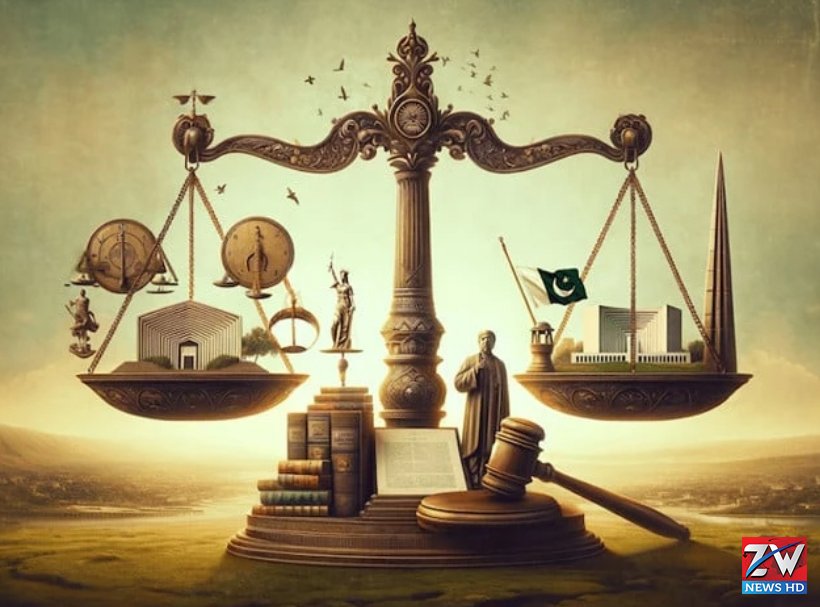
Now that the 26th and 27th changes to the constitution are done, people in Pakistan are talking about making more changes. There’s gossip about a possible 28th change among those who make rules and follow politics, even though officials say nothing is happening.
The ongoing discussion focuses on Pakistan’s continuous financial problem between the national government and the provinces, mainly shown in the ongoing argument about the National Finance Commission (NFC) Award.
Government spending keeps increasing, especially on debt and military. This brings up questions again about money available and how it’s divided, not just as one-time policy talks, but as ongoing, built-in problems.
Experts say this ongoing discussion isn’t really about changing the constitution right away. It’s more about the challenges of how money is divided between the national government, which is struggling financially, and the provinces, whose share of funds is protected by the constitution.
Law Minister Azam Nazeer Tarar said there’s no sign of a draft for a 28th amendment. He added that if they ever want to change the constitution, they’ll talk to their partners first.
His words show they’re still talking about managing population, making local governments stronger, and old ideas for new areas like Hazara and Saraiki.
However, Bilawal Bhutto Zardari said that the Pakistan Peoples Party wasn’t asked about this idea. He repeated that changes to the constitution can’t happen without the PPP’s approval.
Rana Sanaullah, an advisor to the Prime Minister, admitted that officials are talking with the PPP about money problems and how to divide expenses between the national government and the provinces. This is because it costs more to pay off debt and for defense.
He said that even without a set plan, money problems still affect what people talk about when making rules.
Meanwhile, opposition parties, including PTI, are asking the government to explain any planned changes to the constitution.
PTI’s information secretary, Sheikh Waqas Akram, told The Express Tribune that the party’s stance shows it’s a national party. He said PTI wants resources distributed fairly and that the National Finance Commission (NFC) Award needs review. He added that the 7th NFC Award, created after the 18th Amendment, wasn’t properly reviewed after its term ended and has been extended yearly by presidential orders.
In Pakistan, changing the constitution needs more than just political talk. It requires a two-thirds majority vote in both parts of the country’s parliament.
To change the constitution, you need a lot of votes: at least 224 in the National Assembly or 64 in the Senate. No single party has enough votes alone right now. So, parties need to work together. Even if the biggest parties team up, they’d still need help from smaller parties and independent members to get enough votes to make changes to the constitution.
Analyst Mazhar Abbas thinks the government might have a surprise ready. Although it’s just talk right now, political deals are still possible. He doesn’t think the 18th Amendment will be completely undone, but some changes could be negotiated. The 28th Amendment is still mostly guesswork.
Ahmed Bilal Mehboob, the Chairman of Pildat, mentioned that some parts of PML-N’s proposed laws are still unfinished. These could come up again in any future set of constitutional changes, especially the ones about making local governments stronger and changing financial rules.
He also said that ideas about changing how money is shared and creating new provinces are touchy subjects. They need everyone to agree, especially the PPP party, which has usually been against these kinds of changes.
He also noted that making new provinces is very complicated under the constitution. It needs a two-thirds majority in the local governments, so it’s unlikely to happen soon.